
EQUIPMENT / STAR CLUSTER BALL
Star Cluster Ball Table Guide: Surface, Rails & Care
Understand the surface, slope, rails and target placement of a Star Cluster Ball table, with practical checks before play and maintenance.
01 / EQUIPMENT
Why the table deserves its own guide
In Star Cluster Ball, the table sets the conditions for every push. Its playing surface, incline, boundaries and target plates shape how a ball slows, changes line and finally settles. A newcomer can recognize the general layout in photos, yet two tables that look similar may not produce identical rolls. This guide explains what to inspect, ask and maintain without claiming dimensions or materials that have not been verified from a manufacturer.
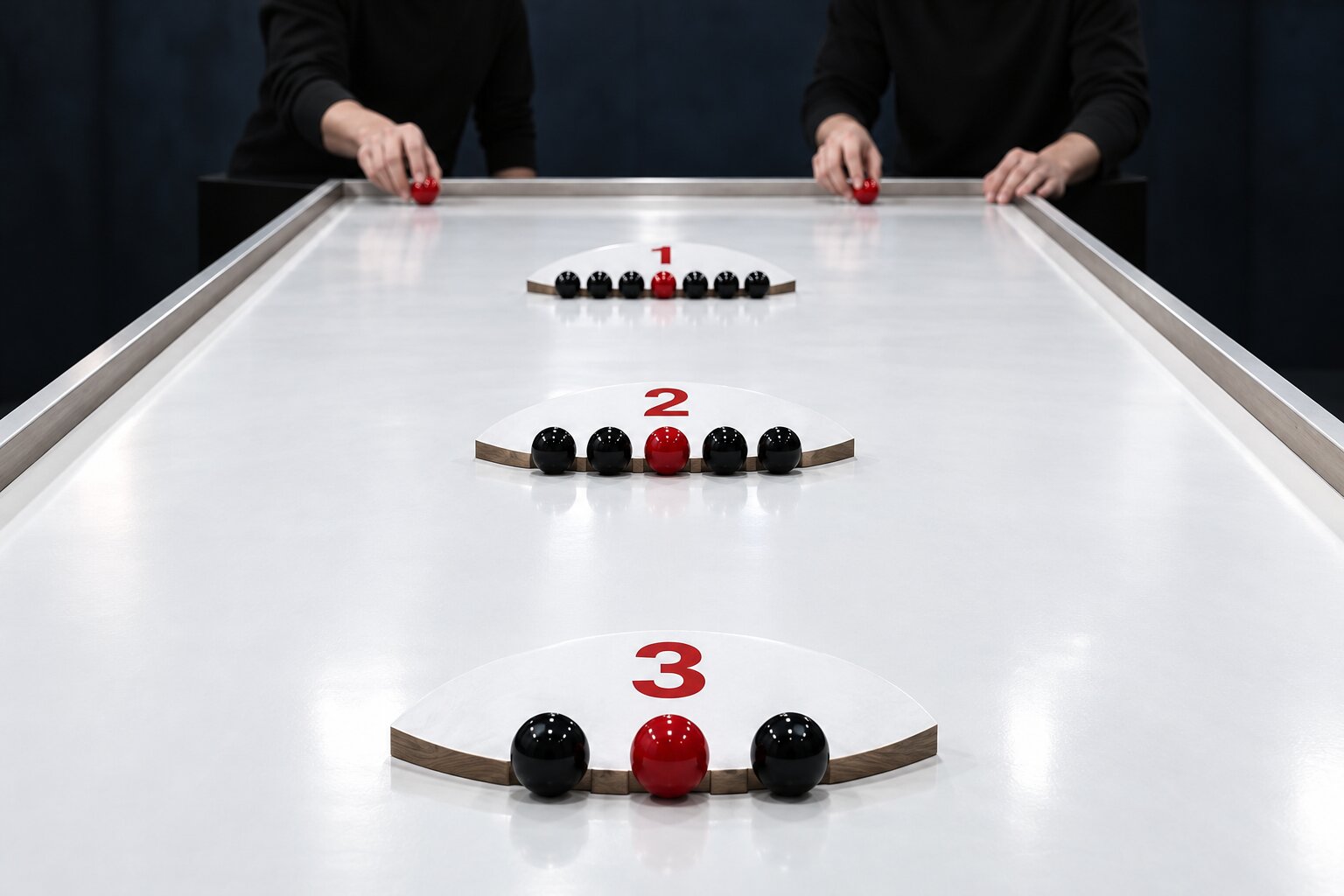
A published Chinese overview describes three semicircular target plates with seven, five and three positions. That is a useful visual introduction, not a complete equipment standard. Before buying, hiring or hosting an event, request the current specification from the supplier or organiser. A venue should be able to identify which table model is in use and which balls and plates are intended to work with it.
02 / EQUIPMENT
Read the table as a complete system
Begin at the release end and follow the playable route toward the targets. Note the surface texture and visible join lines, any intentional incline, the side boundaries and the relationship between the target plates. Ask which marks define legal play and whether a ball that touches a boundary remains live. Even a smooth-looking surface can have a local seam or slight change in friction that matters to a slow roll.
Do not judge a table by the top panel alone. The support frame must hold it stable, the target plates must sit in their intended positions and the balls must be matched to the surface. If a table rocks when leaned on, or a plate shifts during routine play, the positional information players rely on becomes unreliable. Stability is part of the experience, not merely a furniture concern.
03 / EQUIPMENT
Check the level and intended slope
An inclined playing surface must have the intended slope, not an accidental sideways lean. A visibly twisted or unstable support can pull balls toward one rail even when the release is straight. Ask the manufacturer or event organiser how the model is meant to be set up and checked. Do not improvise a slope angle from a photograph. The correct reference is the documentation for the actual table.
For a practical observation, release several balls from the same marked position under comparable conditions. If all drift in the same unwanted direction, pause before blaming a player’s hand. Check the support, surface cleanliness, plate alignment and ball condition. This is a diagnostic exercise, not a substitute for the maker’s calibration procedure. Keep a record of what changed if an adjustment is made.
04 / EQUIPMENT
Inspect the playing surface
The surface should be clean and consistent enough that a small change in release produces a meaningful, repeatable change in result. Dust, moisture, scratches and raised edges can interrupt a slow ball. Inspect under good light from more than one angle; a seam invisible from above may catch a ball traveling along it. Ask the supplier which cleaning products and cloths are safe for the finish.
Avoid applying household polish or lubricant just to make the table feel faster. A treatment can alter friction unevenly, affect the balls and create a condition unlike the one used in other sessions. Follow the maker’s care instructions and test any approved cleaning routine on an inconspicuous area. If a defect changes the route of ordinary play, document it and ask the owner or supplier for repair guidance.
05 / EQUIPMENT
Understand rails and boundaries
Side rails define the visible playing area and may influence a ball that reaches them. Check for loose joints, sharp edges and differences in height or fit along the table. Ask whether rail contact is part of normal play under the event rules. A viewer may see a ball near a rail and assume a deliberate bank; only a complete camera angle or player explanation can support that reading.
Boundary markings need to be legible and consistent. A worn line or decorative stripe can be mistaken for a scoring edge. Before a session begins, identify which line is functional and which is only part of the design. When a ball settles across a boundary, leave it in place until the designated judge or players agree on the call. Moving the ball first destroys the evidence needed for a fair decision.
06 / EQUIPMENT
Check the target plates
Each plate should be securely placed and easy to distinguish. Look at the entrance, the individual positions and any printed number or symbol. Confirm with the event rules how a ball on the lip is judged and whether a plate may be touched during play. A loose or skewed plate changes the route into every position. It can also make a narrow-looking opening either easier or harder than intended.
When comparing equipment, ask whether plates are interchangeable across table models and whether replacements come from the same specification. Do not assume that a plate with the right number of slots has the same dimensions or behaviour. If a host uses a teaching plate or alternate layout, say so before the first push. Players can enjoy a variation when they understand which variation they are playing.
07 / EQUIPMENT
Plan the space around the table
A host needs room for players to approach the release area, spectators to see safely and an organiser to inspect disputed positions. Check that a doorway, wall or furniture edge does not force one side into a different stance. Lighting should make ball colours, target markings and the full route visible without harsh glare. A camera intended for match recording needs a stable position that does not obstruct play.
Think about safe access to balls that leave the intended area. Players should not have to reach over a moving ball or step into another player’s space. Keep bags, cables and loose equipment away from the table. An inviting venue is part of the game’s accessibility: a beginner who can see the route, hear the rules and stand comfortably is better able to enjoy the first session.
08 / EQUIPMENT
Ask for a specification before buying
A buyer should ask the supplier for the exact model, dimensions, weight, materials, assembly procedure, included balls and plates, replacement parts and warranty terms. For a club, also ask about transport, storage and how quickly a worn part can be replaced. If formal events are planned, verify that the model is accepted by those event organisers rather than relying on a generic claim that it is “competition ready.”
Price alone is a poor comparison when the contents differ. One offer may include a stable support, matching balls and clear maintenance instructions; another may show only the playing top. Request photos of the full assembled unit and the target area, and ask for a video of a normal push on the supplied surface. Do not assume that attractive product imagery proves the table’s behaviour or its conformity with any rulebook.
09 / EQUIPMENT
Maintain a consistent playing experience
Before each session, make a short condition check: surface clean, frame steady, plates secure, markings visible and balls undamaged. Note any issue that might affect fairness before a timed match begins. If the table is shared by many users, designate who may clean, move or adjust it. Well-intended changes between rounds can alter play and create disagreement about the results.
After play, store the equipment as the maker recommends and keep balls and plates together with the matching table where possible. Track wear over time: an edge that repeatedly catches a ball, a faded boundary or a plate that loosens after every session deserves attention. A simple maintenance log helps a club fix a small problem before it becomes a debate during a match.
10 / EQUIPMENT
The table is part of the rules conversation
Equipment and rules meet at the point where a ball stops. A regulation may specify what counts in a target, what happens at a boundary and which equipment variation is permitted. Without the current event document, a photograph cannot settle those questions. Before competitive play, the host should show the table, name the approved equipment and explain how edge cases will be judged.
For casual play, an alternative table can still be enjoyable if everyone knows what is different. A shorter session, teaching setup or community prototype should be described as such. Be precise about what you can verify: this table is stable, these plates are fitted, and these rules are in use here. That clarity protects the fun of a small sport as its community grows.
SOURCES & MORE
Independent equipment overview ↗This is an introduction. For competitions and events, follow the organiser’s published rules and equipment specifications.