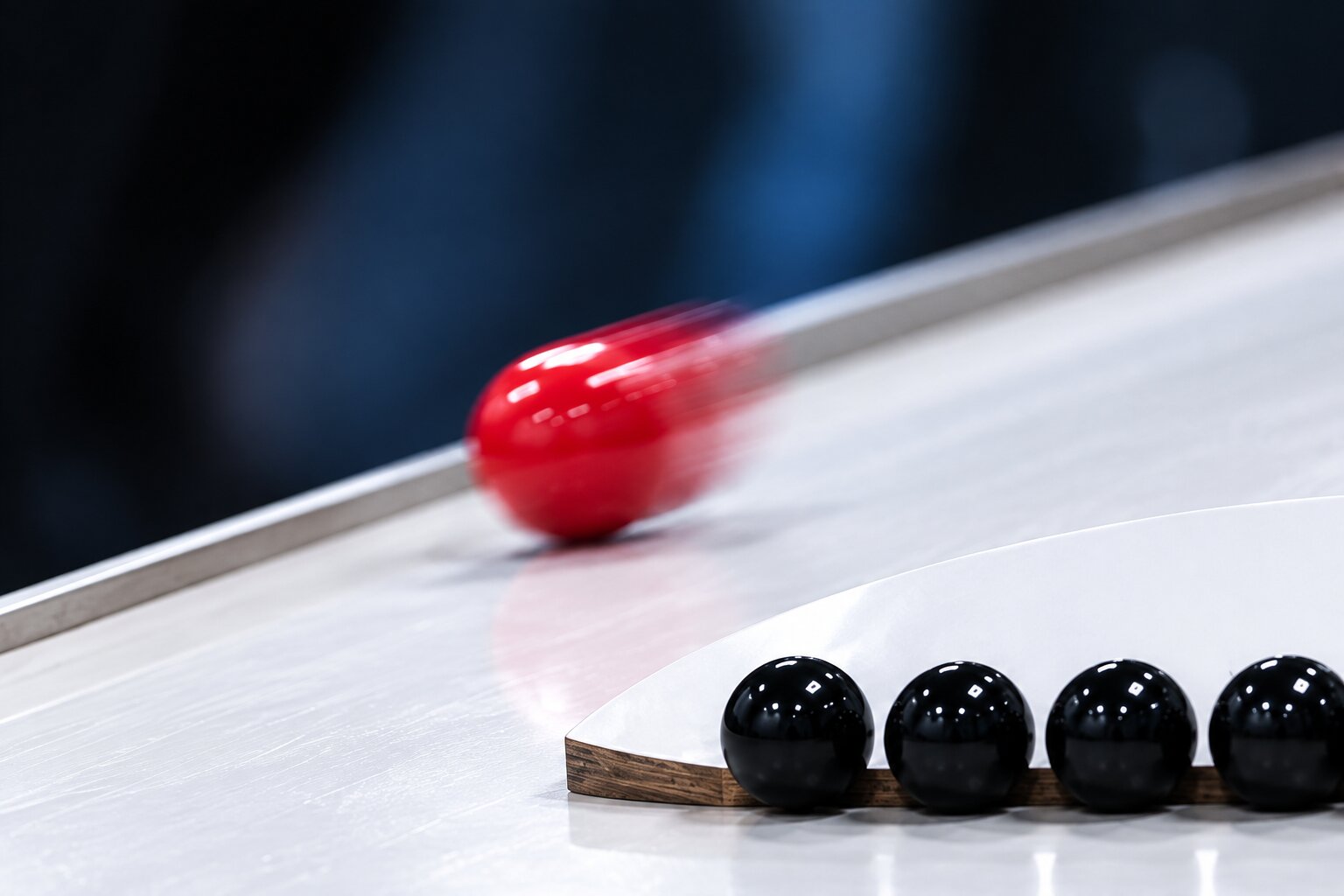

THE EDIT / STAR CLUSTER BALL
How to Watch Star Cluster Ball: Read Position and Momentum
Learn what to watch in a Star Cluster Ball match: ball colours, open positions, a player’s next choice and the reply that follows.

01 / THE EDIT
Start with a viewing map
A Star Cluster Ball match is easier to follow when you know what to look for before the first release. Find the release end, the three target plates, the two ball colours and any scoreboard or clock. Choose one colour to follow for a few turns. Your first job is not to calculate every possible point; it is to see how that side’s position changes after each push. Once you can track one side, the exchange between both sides becomes much clearer.
Footage varies. Some videos show the full table from above, while others use close-ups that make a single ball vivid but hide the overall position. A highlight may omit the rule card, the exact score or the time remaining. Keep a simple distinction between what the camera shows and what a commentator infers. The table offers visual evidence; event rules are needed for formal scoring and judgments.
02 / THE EDIT
Read the table in three distances
The near, middle and far target areas create different visual tasks. When the camera shows the whole table, note which plate receives attention and how balls are distributed across all three. The near plate may contain a crowded group while another remains relatively open. That contrast can explain why a player chooses a less obvious route. Do not assume that an empty far plate is automatically a better choice; reachability and the rules of the current match matter.
If a video cuts to a close-up, use the next wide shot to rebuild your map. Look for balls whose positions changed between shots. A ball that appears to have vanished may have moved outside the cropped frame rather than left play. Pause at a stable frame and identify the same visual landmarks each time. This habit is particularly useful when watching on a phone, where a small image can make colour and plate markings difficult to read.
03 / THE EDIT
Follow one colour, then switch
Choose red or black and record where its balls stand after each of its turns. Are they gathering around one plate, spreading across the table or interacting with the other colour? Follow that colour for several exchanges before switching sides. Tracking both colours at once can overwhelm a new viewer; a single-colour view gives the match a thread you can hold onto.
After switching, ask what the first colour’s moves looked like from the other player’s side. An occupied space may be a protected point, a nuisance that must be cleared or a useful contact surface. This change of perspective prevents every move from being classified as simply attack or defense. In a position-based game, the same ball often helps one plan while creating a new possibility for the opponent.
04 / THE EDIT
Spot the choice before the result
Pause immediately before a release and find two plausible routes. One may aim directly at an open position; another may use contact to alter a cluster. Predict which route the player will try. Even if the ball follows neither line, your prediction makes you attend to the geometry rather than wait passively for a score. Ask what each route would leave for the next turn, not only what it might score immediately.
Your options should be physically credible. A path that looks clear from a high camera angle may be blocked at ball height, and an apparently easy distant plate may require very precise pace. If the event’s rules are not visible, discuss open space and difficulty rather than declaring the highest-scoring move. The goal of prediction is to build a reading of the position, not to prove that a player was wrong.
05 / THE EDIT
Use the scoreboard carefully
When a scoreboard appears, record the score only after a play has been confirmed. A camera may show a ball in a plate before a judge checks the edge, a collision or a bonus condition. The number on screen may also update later than the play itself. If there is a clock, note whether it is running, paused or absent during a replay. These details matter when interpreting a hurried or patient choice.
Public overviews describe scoring ideas, but a competition can choose a particular version or simplified teaching format. Never reconstruct a complete score table from a few edited clips. If a match includes a visible rule card or links to regulations, read them alongside the video. Without them, the safest account is: “The board changed from one displayed value to another after this sequence,” followed by a description of the visible ball movement.
06 / THE EDIT
Notice the stages of an exchange
Early turns often establish positions and test pace; a more crowded table can make later turns about routes and contact. This is a viewing heuristic, not a universal phase rule. Watch how open lanes disappear or reappear as balls settle. A ball that looked irrelevant early may become a reference point for a later decision. A near miss can still change the available path for the other player.
At the end of a timed or limited-ball contest, context becomes even more important. A player may deliberately accept a harder line because a safe, modest placement cannot affect the result. To evaluate that decision, you need the score, clock, turn order and remaining balls. If any are hidden, describe the position and label the strategic explanation as conditional. A short clip supports a sharp observation, but rarely a complete endgame verdict.
07 / THE EDIT
Watch the opponent’s reply
A move is easier to understand after seeing the reply it invites. Does the next player use the opening you noticed, remove a ball from a plate, build a new cluster or choose an entirely different target? Watch two or three turns in a row. A placement that seemed ordinary may have narrowed a route, while a dramatic collision may have left the opponent a comfortable response.
Do not assign all later effects to intention. A player may have sought a different outcome. The observable question is what options existed before and after the push. When an opponent successfully uses a space, ask whether it was visible beforehand or created by the previous move. When the next player avoids a tempting target, ask whether the entry was blocked, the clock mattered or the rules offered another reward.
08 / THE EDIT
Misses reveal pace and plan
A ball stopping short, passing an opening or touching a neighbouring ball gives different information. Describe the miss precisely. “The release was weak” is a stronger claim than “the ball stopped before the plate”; perhaps it touched something or the surface changed. The video may not show enough to explain why. Still, the pattern across multiple attempts can reveal whether a player is adjusting line, pace or both.
A miss also becomes part of the next position. It may block a route, create a new contact point or leave a ball vulnerable to the opponent. This is why the camera should remain on the table after the apparent failure. Watch how the next player responds. The most useful insight may be about recovery rather than about the original target.
09 / THE EDIT
Build a compact viewing note
For one short stretch of footage, write five items: the visible score and time, the colour to play, the most open route, the route actually used and the arrangement after the ball stopped. Leave a blank when the video does not supply an item. The blank is an honest signal of missing evidence, not a failure of observation. A few notes across a sequence make a match easier to remember than a list of isolated highlights.
You can compare your note with the official video description or a rule document if available. If a commentator names a special scoring pattern, find where that pattern appears in the event rules before presenting it as fact. This practice makes your analysis more useful to other viewers, and it helps separate the sport’s stable visual vocabulary from one competition’s particular procedures.
10 / THE EDIT
From spectator to participant
The same questions help at the table. Before your turn, identify your colour, an open route, a possible contact and what your ball might leave behind. Pick one intention, release and observe the result. You do not need to copy a television highlight. You need a reason for your choice and a willingness to update it after seeing the ball move.
Watch a full match, then try a beginner session and return to the video. The second viewing often feels different because you have experienced how hard a seemingly simple line can be. A good spectator notices the craft in modest placements as well as spectacular shots. Game sense grows from repeated comparison between what looked possible, what the player chose and what the table made possible next.
EDITORIAL NOTE
This is an editorial reading of match play, not a competition rulebook. Check the event format for scoring and watch the linked Star Cluster Ball channel for match footage.
Explore the video channel ↗